
Facilities at Mokowe School for Mentally Disabled
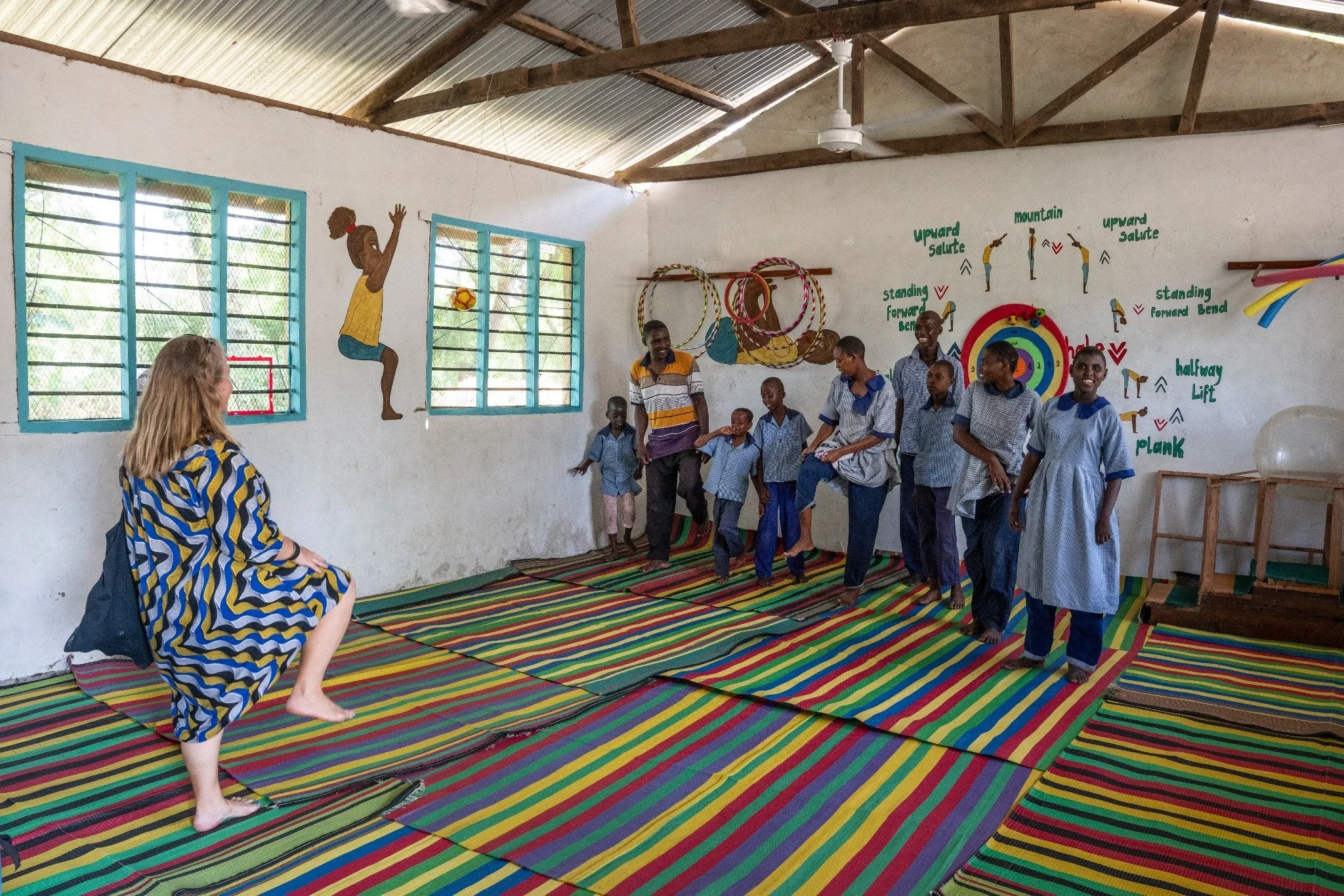
Activity session at Mokowe School for the Mentally Disabled, where students and teachers work together in an adapted space made possible thanks to the support of Be Social Project.
Hello everyone!
Today we would like to tell you about the facilities at Mokowe School for the Mentally Disabled, the small school that Be Social Project has been collaborating with for over a year now.
There are currently 123 children enrolled, although they are not all present at the same time. The school is their home, their place to live, and as such it is divided into different areas. On one hand, we have the dormitories. Usually, around 80–90 children live at the school. There are three dormitories in total: two for boys and one for girls.
Dormitories
The girls’ dormitory, as girls make up roughly one third of the total number of students, is shared by all of them. There is no separation by age, level of knowledge or degree of independence. It is a large, clean dormitory, and there is a woman there—whom they call “mama”—who lives with them. She helps care for the girls, supports their autonomy, and washes the clothes of the youngest ones. In the dormitory, each girl has a cupboard where she keeps her personal belongings.
The boys have two dormitories: one for the younger boys or those with less autonomy, which also has a “mama,” and another for older boys/adults or for younger boys who have enough independence to manage their day-to-day routines.
All the dormitories have bathroom and shower areas, although the showers are not what we might be used to, as there is no running water—something very common in Africa. Water is stored in buckets that are filled every day, and the children wash themselves using a small scoop. The same applies to the toilets: there is no flush system, so water is poured in using a scoop after use.
From a Western perspective, these facilities may seem very basic or insufficient. They are certainly very much improvable, but within African standards, they are above average—believe us.


Kitchen, Dining Hall and Storage
Another part of the house is the kitchen, together with its dining hall and storage area. As you already know, the kitchen has been completely renovated and was the first step in the nutrition project that we run at Be Social Project. It includes a food preparation area, a plating area connected directly to the dining hall, a space to store plates, glasses and pots, a large refrigerator, and a storage room for all dry goods such as powdered milk, flour, lentils and beans.
The dining hall has around 15 long tables with integrated benches, each seating approximately 8 to 10 children.

Classrooms at Mokowe School for the Mentally Disabled
Regarding the classrooms, there are a total of eight. Five of them are used on a daily basis by the teachers with their students. One is a multifunctional classroom that we have just finished, which in the future will become a gym. There is also a classroom known as the “computer room,” although it currently does not have a single computer. Finally, there is another classroom that is not in use and would require a major renovation before it could be used for any purpose.

At Be Social Project, we are going through a difficult moment. At present, all the monthly funds we receive from our members are allocated entirely to the nutrition project, in addition to the €50 monthly fee for administrative services in Spain. Until now, this had been enough, but with the recent rise in prices, we are no longer able to cover these costs.
Multifunctional Classroom
Over the past few months, Be Social Project—together with the help of several volunteers and friends who have passed through Lamu—has launched a new multifunctional classroom. One of its main goals is to encourage children to engage in more physical activity.
We have managed to prepare the space and decorate the walls, and we hope that very soon we will be able to start acquiring materials to help our children carry out adapted exercises. We have received some donations of equipment from schools, but there is still a great deal left to do. We will be sharing more details about this project very soon.
Teachers’ Area
The teaching staff also has its own space: a common area where they hold meetings and enjoy their daily chai, an office for Rose, the headteacher, and another for the deputy headteacher, which also houses the computer and printer that we purchased some time ago.
And these are the facilities of our school—basic, yet dignified. At Be Social Project, we will continue working to improve whatever is within our reach and to help ensure that our children are as well cared for as possible.